
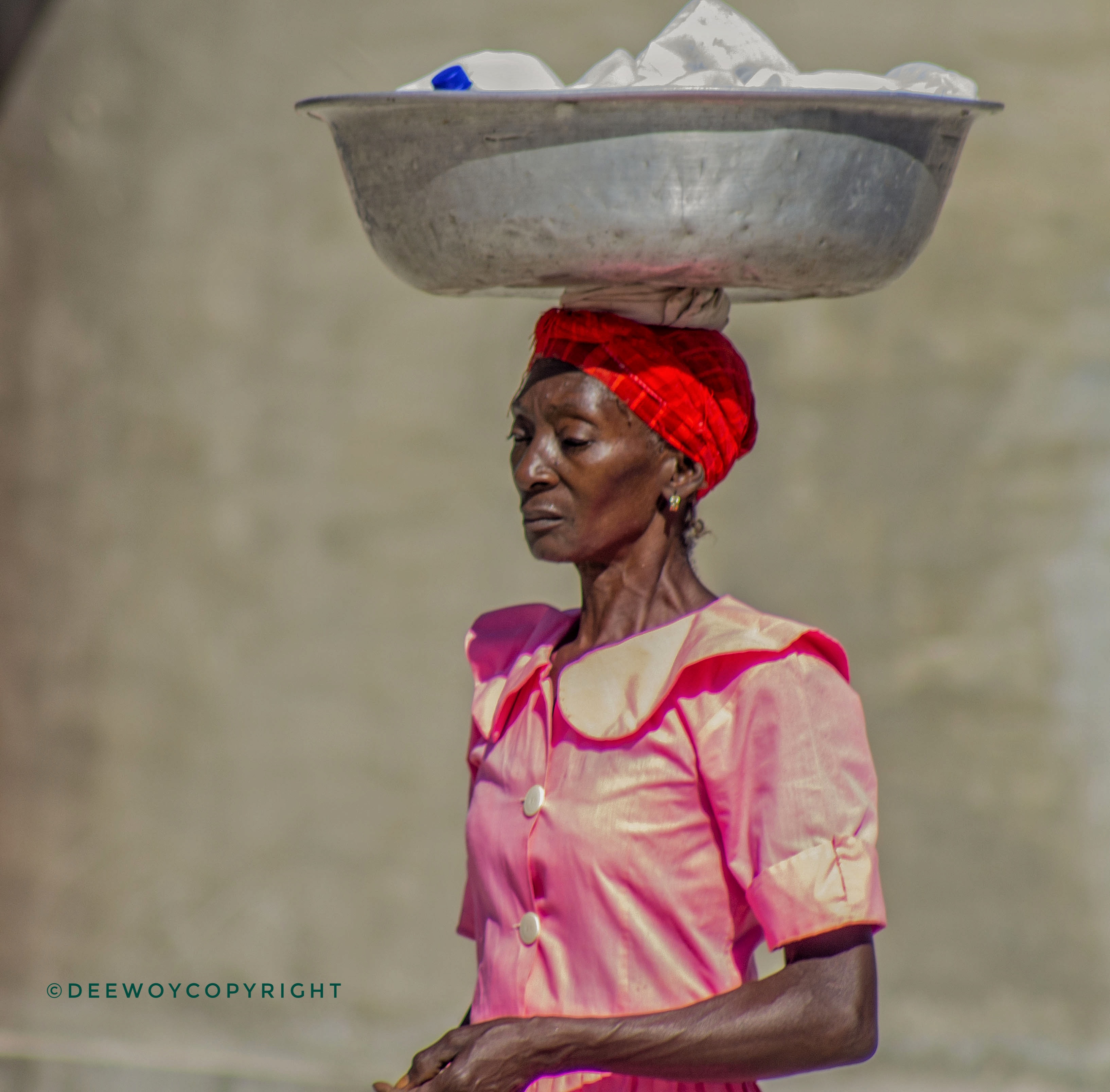
A Madan Sara carrying a basin on her head in Haiti, in 2019.
Photo Deewoy1 · Wikimedia Commons · CC BY-SA 4.0

Madan Sara — Community Activities — Issue 5
Sòl hands, mutual aid, sales, deposits and loans: each has its date, each has its conditions. I follow what each tool brings to the ledger of a market woman or a small farmer.
Guerlyne Petit — November 6, 2026
Documentary reporting and comparative analysis — translated from Haitian Creole
The market keeps its own time
A market woman may have money coming in on Friday and a supplier who needs to be paid on Wednesday. Between those two dates, it is her goods that sit there waiting. Economics, for her, is not a theory: it is a calendar that never agrees with itself.
In the survey the Bank of the Republic of Haiti (BRH) conducted in June 2024 with 25 representatives of the Rasanbleman Madan Sara Dayiti in the West department, 17 said they had a bank account. In the table on debts, sòl appears among the sources of financing people cited. To know how many of those same people use both, I would need to cross-reference their answers. What I can follow here is the work each tool does in trade. [1]
Five tools in the same ledger
I place the sòl beside the four forms the series has followed. The solidarity mutual pools savings and can set up an emergency fund. The producers’ cooperative organizes work, equipment or sales for its members. The credit union is also a cooperative, with a specific job in savings and credit. The commercial bank offers accounts, payments and credit according to its services.
When we call the sòl “the bank that doesn’t ask for papers,” it is an image for the way it pools money. In the comparison, it is also the contributions and the date of each hand that let me explain how it works. The image opens the door; it is the figures that give the tour of the house. [2] [3] [6] [7] [14]
Table 1 — Who puts in the resources, who decides
Resources can be money, a harvest or equipment. The table separates what people bring, the decisions they make, and what they can get in return. [2] [3] [6] [7] [9]
| Tool | What goes in | Who decides | What people get |
|---|---|---|---|
| Sòl | A contribution in each round. | The group sets the rules and the order. The person in charge manages the rounds. | The hand, when the person’s turn comes. |
| Solidarity mutual | Savings, emergency-fund dues, outside financing if any. | Members set the rules for loans and assistance. | A small loan or assistance, depending on the rules and the funds available. |
| Producers’ cooperative | Membership shares, harvest or other contributions depending on the activity. | Members make decisions in the assembly according to the bylaws. | Shared services to produce, process or sell. |
| Credit union | Membership shares, savings deposits and the credit union’s other resources. | One member, one vote. The credit union reviews loan applications. | Savings and credit on the credit union’s terms. |
| Commercial bank | Customer deposits, capital and other financing. | The bank sets the terms of its services under BRH rules. | Accounts, payments and credit depending on the product. |
What money do you have the right to take back?
In KOFIP’s mutual model, the red-box dues go into a collective emergency fund. In the credit union, the membership share goes into the cooperative’s capital and comes with the member’s rights. The savings deposit has its own withdrawal conditions. At the bank, it is the account contract that sets out the customer’s rights over their deposit. If the bank has shareholders, voting rights go with the shares.
When I read a receipt, my first question is: on which line did the money go in? Because each line has its own way out, and not every door opens on the same day. [3] [7] [9]
Anse-d’Hainault and the money that must come back
In a testimony the ILO published in September 2023, the coordinator of the Entre-Nous mutual in Anse-d’Hainault reported that the group had 22 members, and that 12 had received loans to get their cocoa plantations back on their feet. This shows how the fund was used at that time.
To know what the mutual can lend today, I need to see how much is still available and how much has not yet come back. When several members need help in the same week, it is the money in the emergency fund and the group’s rules that decide what they can get. Good will alone cannot fill a cash box. [3] [4]
Dondon and the price that reaches the grower
The directory of Haiti’s National Coffee Institute lists COOPACVOD in Dondon and CACGAVA in Brostage. When growers pool their harvests, they can gather enough coffee for an order and share some expenses. What is left for each grower depends on the quantity they deliver, the quality recognized, the fees deducted and the date they are paid.
I would compare the same quality of coffee, in the same unit of measure. A marmite of cherries and a pound of green coffee can each show a good price. The scale still needs to know what is being put on it. [5] [6]
Milot and the member’s rights
The BRH’s list of licensed credit unions, February 2026 edition, lists the Kès Popilè Leve Kanpe Milo, KPLKM, at entry 48, with a head office in Milot and a branch in Grande-Rivière-du-Nord. The law provides that the National Council of Cooperatives grants authorization to operate after the BRH gives its opinion, and that the BRH supervises credit unions. A member has the right to request a free copy of the annual report.
To know what they can withdraw, or what a loan costs at this credit union, I need the account terms and the applicable fee schedule. [7] [8]
A fee schedule must have a date
In the issue on banking, UNIBANK’s general page showed 325 gourdes a month for the checking account in gourdes. The checking-account sheet for individuals showed 1,300 gourdes plus TCA. It is the fee schedule confirmed by the bank, with its date, that lets me put a price into the comparison. A price without a date is a rumor dressed up in figures.
BRH Circular 131 covers banks and credit unions, among other institutions. For the services it covers, it requires clear information on fees, terms and the price of credit before the customer commits. [9] [10] [12] [13]
When it is hands that are missing
In the markets where Kim WILSON and Mariah LEVIN did their research, sabotay worked like a sòl that turns faster: contributions were often made every day. The konbit, for its part, pools work. Haiti’s report on the Millennium Development Goals documents a konbit in Gambad, in Grande-Rivière-du-Nord, where people brought tools and food to work on a road.
For a field, a konbit can bring hands to prepare the soil while the sòl hand pays for the seed. Money can’t do everything; hands can’t buy everything. When I do the accounts, I write the date of the work next to the date of the money. [2] [11]
Table 2 — What to check depending on the need
I start with what the person needs, then I look for a paper that can confirm the price, the date or the commitment they are making.
| When the need is to | Tool to look at | What to check |
|---|---|---|
| Gather money for a purchase that has a date | Sòl | In the rounds ledger, look at the date of the hand, any fees, and the rule if someone misses a contribution. |
| Get assistance or a small loan | Solidarity mutual | In the fund’s rules, look at which expenses the assistance covers, the ceiling and the time limit. For a loan, ask for the price and the repayment date. |
| Process or sell the harvest together | Producers’ cooperative | On the delivery slip, look at the weight, quality and price. On the receipt, look at the fees, the net amount and the payment date. |
| Put savings aside or apply for credit | Credit union | Check the license. On the statement, separate the membership share from the available savings. For credit, ask for a written offer. |
| Receive a payment or finance an order | Commercial bank | Ask for a dated fee schedule and the payment time. For a loan, look at the net amount, the total to repay and the collateral. |
The first hand still has other rounds
When a person takes their sòl hand early, they get money to spend on that date, and they keep contributing in the other rounds. When they take the hand late, the contributions they have already made serve as a way to put money aside.
If someone who has already taken their hand stops paying, it is the people whose turn comes after who feel the shortfall. The ledger is useful when it shows both what has already come in and the contributions each person still owes. The sòl doesn’t ask for papers, but it does ask for memory. [2]
“Bèf dèyè bwè dlo sal”: the oxen at the back drink dirty water
Let’s take an example. Ten people each put in 1,000 gourdes per round for a hand of 10,000 gourdes. Everyone pays on time, and the group takes no fees in this calculation. If a basket costs 1,000 gourdes when the first hand comes due, the hand buys ten baskets. If the same basket costs 1,250 gourdes when the last hand comes due, the hand buys eight. The price went up 25 percent, and the number of baskets the same amount buys went down 20 percent.
“Bèf dèyè bwè dlo sal.” (“The oxen at the back drink dirty water.”) The oxen in front have already drunk the water while it was clear; the ones at the back find it after every hoof has passed through it. In the same way, the last hand receives the same 10,000 gourdes, but the market has already moved on ahead of it. Patience can help a person keep the money for the date they planned. It is the market price that tells them how much the wait costs.
Two loans facing the same expense
To compare two offers, I put the same net amount, the same currency and the same term on the table. Here are two made-up offers for the same term. In the first offer, 300 gourdes are withheld out of 10,300 gourdes. The customer receives 10,000 gourdes and repays 10,900. The price is 900 gourdes.
In the second offer, they receive the same 10,000 gourdes, repay 10,700, and pay a separate 350-gourde fee after receiving the money. The price is 1,050 gourdes. In the second offer, the total of the installments looks better on paper. It is the fee that does the rest of the presentation, from behind.
What I would measure in the field
I would follow a purchase made by a market woman, from the day she needs the money to the day she sells and pays what she owes. To compare credit union credit with bank credit, I need two dated offers, for the same net amount and the same term. In the cooperative, it is the delivery slips and the proof of payment for the same lot of harvest. In the mutual and in the sòl, it is the ledgers and the group’s rules that would let me follow late payments, contributions and decisions on assistance.
It is these papers that let me move from how the tools are designed to work to what they really do for the people who use them.
What the ledger asks for the next purchase
A small farmer can pool their harvest with other people’s to sell it, receive the payment into an account, and use their sòl hand for expenses that have a date. To say whether the combination works for them, I follow what they earn net, the day they get it, and what they still have to pay afterward.
For people who pool money, I also look at who can ask questions about the accounts and get answers. Five tools, one ledger. It is when I put all these dates in the same ledger that I can see whether the business has enough money to go another round.
Guerlyne Petit — Lakou Kay Gran’n — Kay Nanm Lan — November 6, 2026
« Nou pa sèlman eritye Ayiti nan men zansèt nou; nou prete l nan men jenerasyon k ap vini yo. Ann remèt yo li nan yon pi bon eta pase jan nou te jwenn li. »
Sources and References
[3] KOFIP (2012). Les Musos. Role of the green box, red box and blue box in the model.
[5] INCAH. Réseaux des coopératives. Entries COOPACVOD and CACGAVA.
[8] BRH. Liste de caisses agréées, February 2026, page 2. Entry 48, KPLKM.
[11] Republic of Haiti. Rapport OMD 2013 pour Haïti, volume 1. Konbit in Gambad, page 64.
[12] UNIBANK. Ouverture de compte, general page. Accessed November 6, 2026.
[13] UNIBANK. Compte courant, sheet for individuals. Accessed November 6, 2026.
[14] Guerlyne Petit (2026). Sòl: bank ki pa mande w papye. Madan Sara, Tabou Network, October 20.
Laisser un commentaire