
Bukele in Haiti: Is He the One We Were Waiting For to Save the Country?
Today, November 18, we celebrate Vertières. Two hundred and twenty-three years ago, the indigenous army of Emperor Jean-Jacques Dessalines routed Rochambeau’s French troops, and a people of former slaves decided that no foreign soldier would ever again lay down the law on this land. Two hundred and twenty-three years later, some of our own are taking to the streets to applaud foreign soldiers. And the most troubling part is that we cannot throw stones at them.
So: long live, or down with? Neither. Or rather: not before we have asked the real questions.
A People Crying for Help
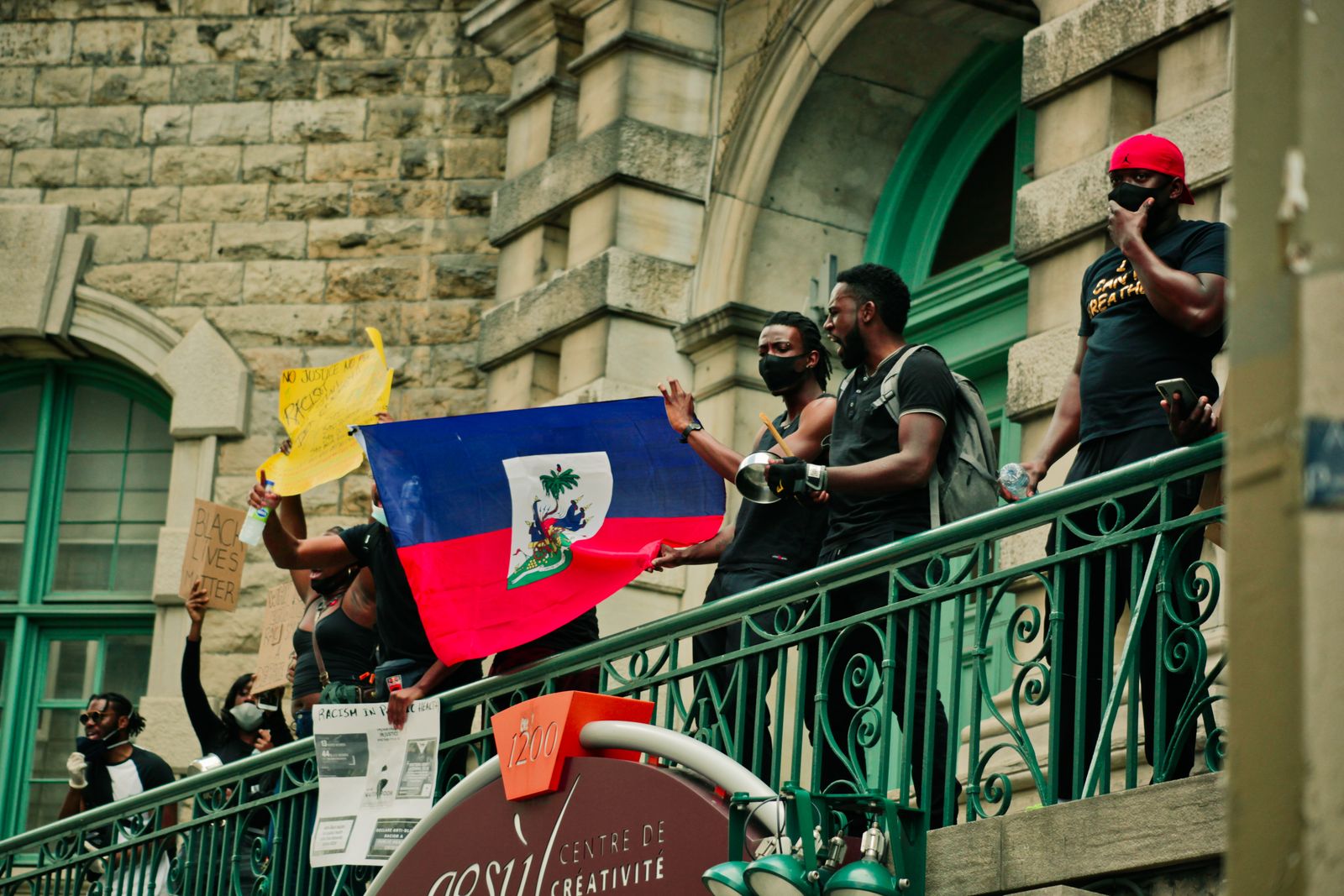
On November 7, in Port-au-Prince and other cities, demonstrators sang in Kreyòl, according to the EFE news agency: « Rele Bukele pou mwen, m ap mouri » — call Bukele for me, I am dying. The placards read: « Bukele, the Haitian people will be grateful to you. » And against the gangs: « Lè yo wè Bukele, kè yo sote » — when they see Bukele, their hearts jump.
We must hear this cry before we judge it. According to the International Organization for Migration (IOM), nearly a million and a half people now live displaced in their own country. Families driven from their homes, market women cut off from their markets, children cut off from school. For them, sovereignty is not a conference word: it means being able to go home, sleep, work, move about.
Manjè ze pa konn doulè manman poul. Those who comment from far away, safely sheltered, have no lessons to give to those who are counting their dead. But pain, however legitimate, does not erase the question that follows.
How Did We Get Here?
On October 18, four Salvadoran aviation technicians, members of the UN-authorized Gang Suppression Force (GSF), disappeared in an ambush near Port-au-Prince. The first Salvadoran soldiers landed four days later. Within a week, according to AFP, there were more than 2,000 of them — more than the UN force itself, which had been there for months. Other sources now put the number at around 2,500.
A savory detail: again according to AFP, it took five days for the Haitian government to officially confirm that these troops had arrived on its own soil. El Salvador sent helicopters; the Haitian State sent a press release, late.
President Nayib Bukele, for his part, speaks directly to us, in Kreyòl, on X. He promises to help the people « take back the country from the traitors who betrayed Dessalines’ legacy, » according to Le Nouvelliste. So here is a foreign president coming to talk to us about Papa Nasyon, two weeks before Vertières. Dessalines must have turned in his grave. Not only out of anger, perhaps. Perhaps out of surprise and astonishment: he thought his heirs could still read his testament.
What We Have Not Been Told
According to the UN, as reported by Reuters, the « vast majority » of Salvadoran soldiers operate outside the UN force. Neither Port-au-Prince nor San Salvador has made public the exact number of soldiers or how long they will stay. Amnesty International has called for the agreement between the two countries to be published and for operations to respect human rights. The Council on Foreign Relations, in Washington, is also calling for the publication of the agreement and of the rules of engagement, which remain unknown.
On November 16, our minister in charge of security, Patrick Pélissier, was in El Salvador to meet Nayib Bukele. According to Reuters, the Prime Minister was preparing meetings on a possible extension of the operation.
An extension of what, exactly? Of an agreement the people have never read. Who is in command on the ground? For how long? Under what rules for the use of force? Who investigates when a civilian falls? A pact between leaders does not replace public debate on the presence of a foreign army. The Constitution does not say « national sovereignty resides in the Prime Minister. » It says: in all the citizens together.
And what does sovereignty mean to a market woman who can no longer reach her market, to a farmer who can no longer sell his harvest, to a displaced mother sleeping under a tarp? It must also guarantee them the right to work and move about freely in their own country. That is why the debate is so hard: a people is asking for protection right now, and a foreign military presence that drags on raises the question of our political independence. Both are true at the same time.
Who Will Answer for the Dead?
The United Nations Integrated Office in Haiti (BINUH), as cited by the Council on Foreign Relations, counted 87 civilians, including 21 children, killed by drone strikes between July 2025 and September 2026 — strikes linked to the private military company the Haitian State hired in March 2025, not to the Salvadoran troops. Yet these deaths tell us something: here at home, when a weapon kills an innocent person in a gang-controlled neighborhood, no one is held accountable. A family living under a gang’s law is not the gang. It is its hostage. Every force, Haitian or foreign, must know this before it fires.
The Salvadoran Model, Up Close
In Le Nouvelliste on November 16, economist Thomas Lalime traces El Salvador’s transformation: a homicide rate that fell from 106.8 per 100,000 inhabitants in 2015 to 1.9 in 2024, and an economy that grew by nearly 24.5% in ten years while Haiti’s shrank by about 14.8%. The result is impressive, and we would be wrong to ignore it. Lalime does not hide the other side of the coin: a state of exception since March 2022, more than 90,000 arrests according to Human Rights Watch, constitutional judges removed, presidential re-election made indefinite. He himself warns against « mechanically reproducing the model » of Bukele.
Above all, El Salvador had a State. Battered, contested, but a State: prisons, courts, an administration that took over from the soldiers. Here, who will take over?
After Bukele, Who Will Bring People Home?
Because Bukele will leave. He has said so himself: when the mission is over, his soldiers will go home. Chodyè prete pa bouyi pwa sèch. When he leaves, we will be left with what we have.
The day the last Salvadoran armored vehicle leaves Port-au-Prince, who will hold the streets? Who will rebuild the burned neighborhoods, the broken roads, the emptied villages? Who will reopen the schools, the markets, the health centers, the courts? Who will stop criminal networks from regrouping? And above all: who will bring these hundreds of thousands of displaced people home? A military operation can change the balance of power. It cannot, on its own, build a State governed by the rule of law.
This is where chaos lies in wait. In this country, a large share of the land has never been surveyed in the cadastre, and the land registries are not up to date. How many property titles went up in smoke with the houses? How many families never had any proof other than their neighbors’ word? When the neighborhoods are « liberated, » the gang gone, the speculator will arrive. With a forged paper, an obliging surveyor, a judge in a hurry. Those who fled the bullets may come home to find another owner in their yard.
Liberating a territory is a military operation. Returning each house to its rightful owner is the work of a State: counting the houses, protecting the evidence, hearing the witnesses, settling disputes, compensating. No foreign soldier will do that for us. N ap dekouvri Sen Pyè pou kouvri Sen Pòl. Driving out the gangs only to hand the land over to thieves in neckties would not be a victory. It would just be misery changing owners.
The Gang Problem Does Not Begin with the Gangs
A gang is not born fully armed in a back alley. Rifles and ammunition do not grow in the gardens of Martissant or Croix-des-Bouquets: they cross borders, ports, customs. Ransom money does not sleep under a mattress: it circulates, gets laundered, gets invested. As long as we do not trace these circuits back, as long as political and economic complicity established by evidence goes untried, we will be cutting branches and leaving the root. A lasting policy requires financial investigations, a police force that is equipped and held accountable, an independent judiciary, and public services in the neighborhoods the State has abandoned.
The Haitian State Facing Its Responsibilities
When citizens wave another country’s flag to thank its president, it is not first and foremost Bukele they are applauding. It is the absence of their own State they are denouncing. Has the National Police received the means it was promised? Where have the security budgets gone? Through what channels do weapons and ammunition keep reaching the gangs? What complicity has been established, prosecuted, tried?
It would be unfair to place this weight on police officers alone, some of whom have died in the line of duty while others work in undignified conditions. The primary responsibility lies with the leaders, who control the resources, the justice system and oversight of the armed forces. Bringing in foreign soldiers exempts no government from accountability. Pa jete chodyè ize pou chodyè nèf. The new pot is borrowed; the old one is our police, our justice, our administration. That is the one we must repair, because that is the one that will stay on the fire.
Long Live or Down With: Must We Pick a Side?
« Long live Bukele! » is the relief of those who can finally breathe. « Down with the occupation! » is the memory of a people who lived through the American occupation from 1915 to 1934, and the cholera introduced in 2010 by MINUSTAH peacekeepers. Not all interventions are alike, and international cooperation is not illegitimate by nature. But that memory demands vigilance and accountability. Both cries are sincere. Neither answers what matters most: how many civilians protected? What abuses committed, and tried? What institutions strengthened? What commitments kept, and before whom?
Our role is neither to shout with the crowd nor against it. It is to ask the questions nobody wants to hear, while there is still someone left to answer them.
And the Generations to Come?
On November 18, 1803, our ancestors did not wait for someone else to come and save them. They understood that freedom given can be taken back, and that only the freedom you build endures. So the question of this Vertières 2026 is not: should we love or hate Bukele? It is: what are we doing so that our next children will never again need to call on a foreign president to sleep in peace in their own homes? The task is not only to take back territory. It is to build a country where security, justice and sovereignty are no longer promises forever postponed.
Guerlyne Petit
Lakou Kay Gran’n — Kay Nanm Lan
November 18, 2026
Nou pa sèlman eritye Ayiti nan men zansèt nou; nou prete l nan men jenerasyon k ap vini yo. Ann remèt yo li nan yon pi bon eta pase jan nou te jwenn li.
Sources
- International Organization for Migration (IOM), via UN News, June 2026: nearly 1.5 million displaced people in Haiti.
- EFE, November 7, 2026: demonstrations in support of Bukele in Port-au-Prince and other cities.
- AFP, October 29, 2026: deployment of more than 2,000 Salvadoran troops; confirmation by the Haitian government after five days.
- Reuters, November 16, 2026: Minister Patrick Pélissier’s visit to El Salvador; the UN says the « vast majority » of troops operate outside the GSF; numbers and timeline undisclosed.
- Le Nouvelliste, November 2026: Nayib Bukele’s statement to the Haitian people on « Dessalines’ legacy. »
- Thomas Lalime, « Le Salvador, du repaire des gangs armés à un havre de paix sous le règne de Nayib Bukele », Le Nouvelliste, November 16, 2026.
- Sam Vigersky, « El Salvador’s Troops Are Fighting Haiti’s Gangs. Who Is Protecting Civilians? », Council on Foreign Relations, November 17, 2026 (BINUH figures on drone strikes).
- EFE, November 2026: El Salvador says it will withdraw its troops once the missing soldiers are found.
- Amnesty International, call to publish the Haiti–El Salvador agreement (reported by EFE, November 2026).
Photo: Dorothy Mombrun — Pexels
Laisser un commentaire