
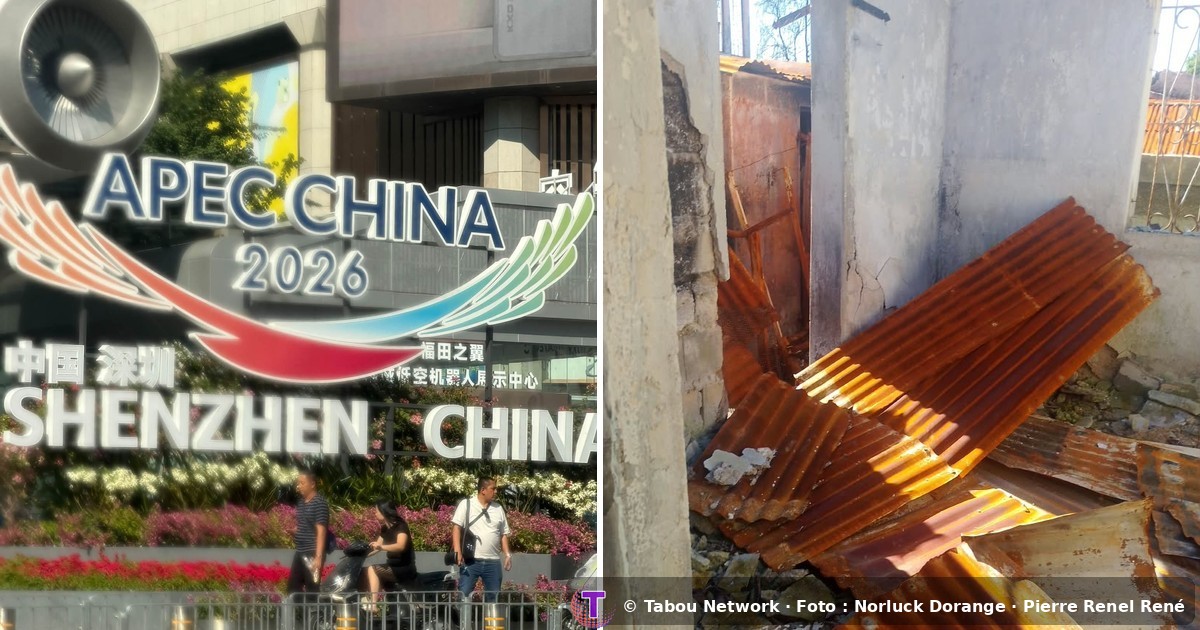
While Shenzhen made its skyscrapers dance for the leaders of 21 Asia-Pacific economies, we, at home, were hunting for power to charge our phones. Not to be jealous, but to do the math: what can we learn from China, and where are we already tied to it without knowing?
Light. Money. Lesson.
A week before the APEC summit, every evening for four days, Shenzhen’s towers became giant screens: colors turning together across the glass, the words « APEC CHINA 2026 » scrolling high above, people standing in the street with their phones raised. On November 18 and 19, the leaders of 21 Asia-Pacific economies were there. China’s president, Xi Jinping, went all the way to the airport to welcome the American president, Donald Trump, the very man who opened 2025 with heavy tariffs on goods from every country, China first of all. Whether the show left his head spinning, only he knows. But China did not do it for nothing: a country that wants to show its strength does not need to raise its voice.
Journalist Norluck Dorange, a friend of ours who travels to China every year, had already said it on his Facebook page. In his view, tariffs were never going to bring the American factories in China back home, because the United States offers them no conditions that can replace what they find over there. American consumers would pay the difference, in prices. China is too deep inside American homes, he says. Want proof? Walk into your bedroom, open the closet, read the labels.
One Camera, One Truth
But the biggest lesson is not in the tariffs. It is in our eyes. For a long time, the big media sold a single image: « Communist China, » therefore misery, therefore people chasing a piece of bread. We know that game better than anyone. The same cameras say our country is nothing but poverty and misfortune, that Vodou is Satan. One camera, one version, and the world takes it for the whole truth. When it comes to world order, even the United Nations plays police officer in small countries like ours, yet its voice grows faint before the great powers waging war. There are many truths on this earth; not all of them have a camera.
Soulye ki ka di w konbyen twou ki genyen nan chosèt.
Those who went to see for themselves come back with numbers that don’t dance. According to the World Bank, over 40 years the number of Chinese people living below the extreme poverty line fell by nearly 800 million. In 2025, China generated 10,578 terawatt-hours of electricity; the United States, 4,520. More than double. Every year, its universities turn out more than a million engineers. Shenzhen itself was made a special economic zone by the Chinese state in 1980. Today, about 70 percent of the country’s consumer drones are made there.
That does not make China a paradise. A single party rules, and elections there do not work the way we know them. Rayi chen, di dan l blan. A country does not have to govern the way we do for us to study what it got right.
Where It Touches Us
Our textile industry lives on a law other people vote on. The HOPE/HELP program, which lets clothing sewn at home enter the United States duty-free, died on September 30, 2025. It was revived in February 2026, but only until December 31, 2026. In September, the U.S. House of Representatives voted to extend it through the end of 2028. Every two or three years, workers in the factories of Port-au-Prince and Caracol wait on the vote of a Congress where they have no voice. Mayo prete pa kouvri senti.
Power is the foundation. While Shenzhen makes its towers dance, we live by tèt gridap lamps, generators and inverters. According to the World Bank, only 45 percent of the population has access to electricity, with a harsh gap between town and countryside. No factory without power, no free zone without power, no young engineer inventing anything in the dark. Meanwhile, China makes most of the world’s solar panels, and the country’s electrification plan is already counting on solar mini-grids with batteries. The question is: who will negotiate the price, and for whose benefit?
Se konnen ki fè. China ties school to work, credit to production. At home, the Madan Sara carries the economy on her head, yet she finds credit only in the sòl and the mutual savings groups, because the banks do not see her. When will we have a development bank that knows the road to the market?
We don’t recognize Beijing, but we build with its iron. The country has recognized Taiwan since 1956; in April 2026, the state celebrated 70 years of that relationship. Yet in 2016, iron and steel topped what we bought from China, when the total reached 282 million dollars. That iron holds up the concrete of our homes. We don’t have to pick a side on someone else’s say-so: this question deserves a public debate about our own interests.
Downtown: Rebuild, But for Whom?
Look at Port-au-Prince today. Nayib Bukele’s soldiers, the National Police and the Task Force have come through to show who the masters of this country are. Some bandits are on the run; they have saved their skins and scattered: pye, sa m manje m pa ba w! But not all of them. Downtown was never the bandits’ home; they were dug in at a few specific spots, and from there they came out to attack whoever passed by. No one dared go down there anymore. Those hideouts are still there today, and the roads are not yet clear. But look at the havoc they leave behind: they flattened Port-au-Prince and all its surroundings; everything is destroyed, burned, torn down.
A journalist friend who works in Port-au-Prince tells me what people are saying under their breath: the people are glad, but the people are afraid. When they march to thank Bukele, it is to encourage the soldiers; but everyone is watching carefully. One question is on every lip: if the soldiers leave tomorrow, what will become of us? Her mother, who was there while we talked, was even more pessimistic. People have not forgotten the protection gangs found among those who sit in power and those who hold money: since 2022, Canada and the United Nations have sanctioned politicians, former ministers and major businessmen for backing the gangs. The battle is not won yet. Bukele must hold on, and hold on again, before anyone can say: thank you, we are free! Dèyè mòn gen mòn. But starting now, we must get ready to rebuild. There is no other choice. The question is not only when people will go home; it is what kind of city they will go home to.
We already know reconstruction talk. After January 12, 2010, plans for a « new Port-au-Prince » came one after another, with drawings and scale models, in the ballrooms of Pétion-Ville’s big hotels. In 2010, the state declared downtown a zone of public utility; in 2012, another government repealed the decree. Gran van, ti lapli. This time, to rebuild, we need a plan. Not a hotel-ballroom plan: a five-, ten-, fifteen- and twenty-five-year plan, with a law, money and a timetable. A plan every future government is bound to follow and carry out, without tearing everything down to start from zero.
That is why Shenzhen deserves a close look: not to copy it, but to dig into it. The city’s first master plan, in 1982, expected one million residents by 2000; there were about ten million. In the 1980s, the state gave land to public enterprises to develop five hubs separated by green corridors. China learned from Hong Kong how to lease the right to use state land, and that money built the roads, the power lines and the water. The land paid for the city.
But there is another side: where does the money come from? Researchers show that investors gained the most from this land policy, more than tenants and local government. And it was the « urban villages, » old farming hamlets swallowed by the city, that gave migrant workers a place to sleep when the official plan did not see them.
The lesson for us is clear: a master plan that looks far ahead; land that works for the state and for the community; our own engineers and architects leading the work. And the people of downtown, of Cité Soleil, Martissant, Carrefour and the Plaine, seated at the table, with the right to go back home. If we rebuild without them, we will only change landlords. A city is not just buildings; it is the people who live in it.
Shenzhen was not built in a day. It took power, schools, credit, a plan, and time. Piti piti zwazo fè nich li. Where we stand today, we have no right to wait for another camera to tell us who we are and what we can do.
Nou pa sèlman eritye Ayiti nan men zansèt nou; nou prete l nan men jenerasyon k ap vini yo. Ann remèt yo li nan yon pi bon eta pase jan nou te jwenn li.
Guerlyne Petit
Sources
- Norluck Dorange, « Anba Mapou Vodoun a — Trump, Shenzhen, epi MAGA, » Facebook post, November 2026.
- Bastille Post / China Media Group, « China Media Group lights up Shenzhen skyline for APEC meetings, » November 12, 2026.
- Radio Free Asia (Reuters photo), « Smiles and hugs ahead of Trump, Xi and Putin’s highly anticipated meeting, » November 18, 2026.
- World Bank, « Lifting 800 Million People Out of Poverty – New Report Looks at Lessons from China’s Experience, » April 1, 2022.
- Pew Research Center, Ember data (Yearly Electricity Data), electricity generation 2000–2025, 2026.
- South China Morning Post, UNESCO figures on engineering graduates in China.
- Shenzhen Government Online (Xinhua), « APEC host city Shenzhen offers glimpse of China’s future industries, » August 10, 2026; drone show for the special economic zone’s 45th anniversary, August 27, 2025.
- U.S. Department of Commerce (trade.gov), « Haiti HOPE/HELP Sunset FAQs, » January 2026; White House, proclamation implementing the Consolidated Appropriations Act, 2026, May 2026; AAFA, September 1, 2026.
- World Bank, « Improving healthcare access through renewable energy, » May 27, 2025; « World Bank to Support Sustainable Energy Access in Haiti, » October 18, 2024.
- Fortune, « These charts show how China is pulling ahead of the U.S. in the race to power the AI future, » August 5, 2025.
- Le Nouvelliste, « Haïti et Taïwan, un partenariat tourné vers l’avenir, » April 17, 2026.
- Haitian National Police (PNH), announcement of the recapture of Sylvio Cator Stadium and of the joint operation in downtown Port-au-Prince, November 12, 2026, as reported by Juno7, « Stade Sylvio-Cator : la PNH annonce sa reprise, Bukele avertit les gangs, » November 13, 2026.
- Juno7, « À Martissant, une opération contre les gangs signalée avec des drones explosifs, » November 19, 2026.
- Testimony of a journalist in Port-au-Prince, November 22, 2026.
- Global Affairs Canada, sanctions against Haitian political elites (November 4 and 19, 2022), economic elites and former ministers (December 2022; January 13, 2023) for supporting gangs.
- United Nations, interim report of the Panel of Experts on Haiti, S/2026/241, 2026.
- AFP, photo by Clarens Siffroy: municipal workers clearing debris in Port-au-Prince, November 16, 2026.
- HaitiLibre, Port-au-Prince reconstruction plans, January 28 and August 11, 2011; repeal of the public-utility decree on downtown, May 30, 2012.
- Juan Du, « Demystifying Shenzhen: The Informal in a Planned City, » ETH Zurich, 2019.
- Journal of Urban Affairs, article on Shenzhen’s spatial planning, 2017 (doi 10.1080/07352166.2016.1271623).
- Lee Kuan Yew School of Public Policy (NUS), « Winners and losers in China’s urban transformation, » September 6, 2018.
- Jieming Zhu, « Changing Land Policy and its Impact on Local Growth: The Experience of the Shenzhen Special Economic Zone, » Urban Studies, vol. 31, no. 10, December 1994.
- United Nations COMTRADE database (via Trading Economics), Haiti’s imports from China, 2016.
Featured image: Shenzhen (Photo: Norluck Dorange) and a burned house on Rue Chavannes, Port-au-Prince (Photo: Pierre Renel René).
Laisser un commentaire