
Report — Education / Tabou Network
Visit and interviews: November 18, 2026, Lakou Granchimen, Caracol (Nord-Est)
By John Joseph
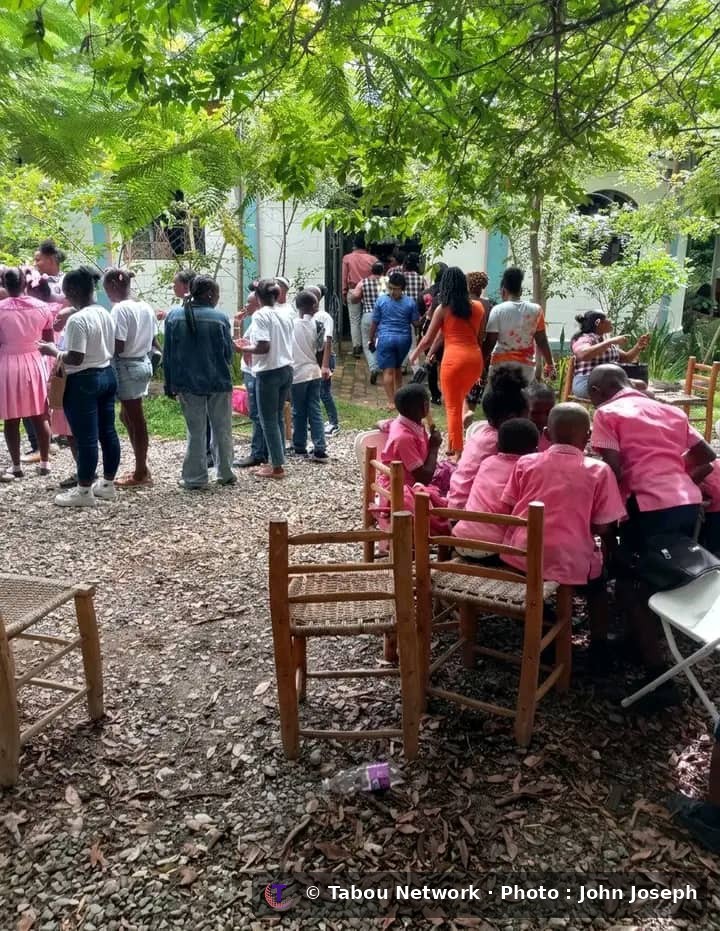
To mark the anniversary of the Battle of Vertières (November 18, 1803), a landmark date in our national history, the administration, teachers and students of Institution Schesche in Limonade went on an educational and cultural outing to Lakou Granchimen, in Caracol.
Bringing together pupils from preschool through 9th grade, the initiative aims to strengthen young people’s sense of citizenship and cultural identity through the discovery of Haitian peasant heritage. For the school’s administration, other schools across the country should take the same approach.
Immersed in heritage and culture
On site, participants explored a rich exhibition of paintings and traditional objects that bear witness to the way people used to live. The day unfolded in a warm, festive mood, with dancing, card games, shared meals and conversations about the country’s history.
For Ansège Louidor, Institution Schesche’s head of academics, the activity is vital at a time when cultural landmarks are fading:
“This outing is very important for us, because we have lost a lot, and the children need to know their country’s history better. I had already considered a visit to the museum in Limbé, but today we are at Lakou Granchimen. When it comes to identity, forgetting what belongs to us will have heavy consequences for the country’s future.”
The school’s director, Myrtha Jean, stressed what the students learned in practical terms:
“During this visit, they discovered mystical items, paintings and old objects such as the pilon (wooden mortar), the nèstre, the tòk, the old kawo, the makout (straw bag) and the sleeping mat. If you had asked them what a makout is placed on, they would not have known that it goes on the back of a horse or a donkey.”

Retay bon twal pa jete
The event also drew Jimmy Bien-Aimé, director of Collège Saint-Étienne, who had introduced the site to Institution Schesche’s leadership. Speaking to Tabou Network, he praised the initiative and called for reflection on changing technology and local production:
“This museum is very important for students from the town center, who have no idea of rural life. Past generations used the ganmèl (a large wooden basin) and the batwèl (a wooden laundry paddle), made locally in Haiti, while today’s generation uses washing machines. A whole process brought us here, but today almost everything we use comes from abroad. We need to think about how we can draw on the past to move forward on our own.”

Students won over
Among the students, the excitement was obvious. Doudenaïka Joseph, a 6th-grade student, shared what she took away from a day outside the classroom:
“My school took us to discover many objects our ancestors used. Back then, there were wooden basins, and people slept on mats before rugs came along. I already knew the mat, but I discovered many other things I had no idea about.”
With this outing to Lakou Granchimen, Institution Schesche set out to combine remembrance and civic education, putting its students in direct touch with their roots.
John Joseph
“Nou pa sèlman eritye Ayiti nan men zansèt nou; nou prete l nan men jenerasyon k ap vini yo. Ann remèt yo li nan yon pi bon eta pase jan nou te jwenn li.”
Translated by Guerlyne Petit / Tabou Network
Laisser un commentaire