
By Dieula St Julien — Tabou Network
A city choking at its heart
Every morning, the historic streets of Cap-Haïtien wake up to a shrill concert of horns and a thick black smoke. From Madeline to Pont Neuf, from the « lettre L » to Plaine-du-Nord, Haiti’s second city is suffocating under motor traffic that no one controls anymore. For the hurried city dweller, this daily chaos is counted in hours lost in traffic jams. But behind the windshields and the clouds of exhaust lies a far larger tragedy, invisible and silent. This disorder on the roads hangs like a sword of Damocles over the economy of the Grand Nord. Far from the city’s asphalt, it seeps into the rural communal sections and strikes, head-on, the people who feed the region: small farmers. In Cap-Haïtien, the transport crisis is no longer a mere urban nuisance; it has become a machine that grinds down rural life, ruining its economy and decimating its youth.
From leisure bike to moto-taxi
For most of the twentieth century, Haiti’s roads belonged to private cars, trucks and the pickup buses known as « tap-taps », and, in the countryside, to donkeys, mules and horses. Motorcycles existed, but they were marginal: a leisure vehicle or a private tool for the middle and upper classes, not yet a means of public transport.
The moto-taxi came from the Dominican Republic. According to Le Nouvelliste, it made a timid appearance in Haiti in July and August 1987, then took hold during the 1990s. It was born of a desperate need to get around: growing traffic jams, overcrowded buses… Drivers began offering quick rides on the back of their two-wheelers.
By the early 2000s, the habit had taken deep root. Motorcycles gathered at informal stands across the capital and the major provincial towns. They became the only means of transport able to dodge urban chaos and reach working-class neighborhoods whose alleys are too narrow for cars.
After the 2010 earthquake, on broken roads and amid the rubble, the motorcycle became king. The massive arrival of cheap Chinese brands turned an already entrenched habit into road saturation.
Cap-Haïtien followed the same curve. A traffic survey carried out in 2021 for the RUTAP project shows that two-wheelers make up the largest share of vehicles on the roads studied: between 42% and 60%. Local phenomena emerged, such as the « Chawa Pete »: light motorcycles, mostly of the Gato brand, imported from the Dominican Republic, modified to attract young people and ridden at high speed. They appeared around 2016–2017 and take their name from the rabòday music their drivers play very loud, nonstop.
Today, with the recent arrival of three-wheelers, the tuk-tuks, two- and three-wheeled transport is part of the visual and economic identity of Cap-Haïtien’s streets.
Selling the land: the decapitalization of farmers
To grasp the scale of the disaster, you have to leave downtown and go down to the fertile plains of Limonade, Quartier-Morin or Acul-du-Nord, not to say the whole great plain of the North. For the Haitian farmer, land is much more than a work tool: it is the only bank, the only capital, the inheritance of a lifetime of labor. Yet, with traditional farm markets collapsing and young people seeing no future, a destructive practice has taken hold. The father of the family makes the ultimate decision, the last resort: he sells a plot of his arable land. This is not only happening in the North: all over Haiti, families are selling their land to buy a motorcycle.
The purpose of this sacrifice? To buy his son a motorcycle. In the farmer’s mind, the motorcycle shines like an economic mirage, the promise of an immediate daily income in a country where organized public transport has all but disappeared. But too often, this choice turns into a financial trap. By stripping himself of his land, the farmer trades his long-term means of production for a very fragile investment. The compulsory insurance of the OAVCT, the Haitian third-party vehicle insurance office, covers damage done to others, not the motorcycle itself. The first theft, the first major breakdown or the first accident turns this sacrifice of land into a clean and final loss. The land is gone, the money has flown away, and poverty settles for good in the farmer’s yard. As the Haitian proverb says, « Vann manman poul pou achte ze »: he sold the hen to buy eggs.
The tragic last stop: Justinien University Hospital
The motorcycle mirage comes to an abrupt end where the numbers begin. According to Le Nouvelliste, motorcycles are involved in nearly 60% of road accidents in Haiti. With no driving-school training truly required, no rigorous control of driver’s licenses and no adequate roads, young drivers rush onto the asphalt without any preparation. No helmets, excessive speed and the pressure to make money turn carrying passengers into a deadly lottery. The roads of Cap-Haïtien do not just carry lives: they cut them down.
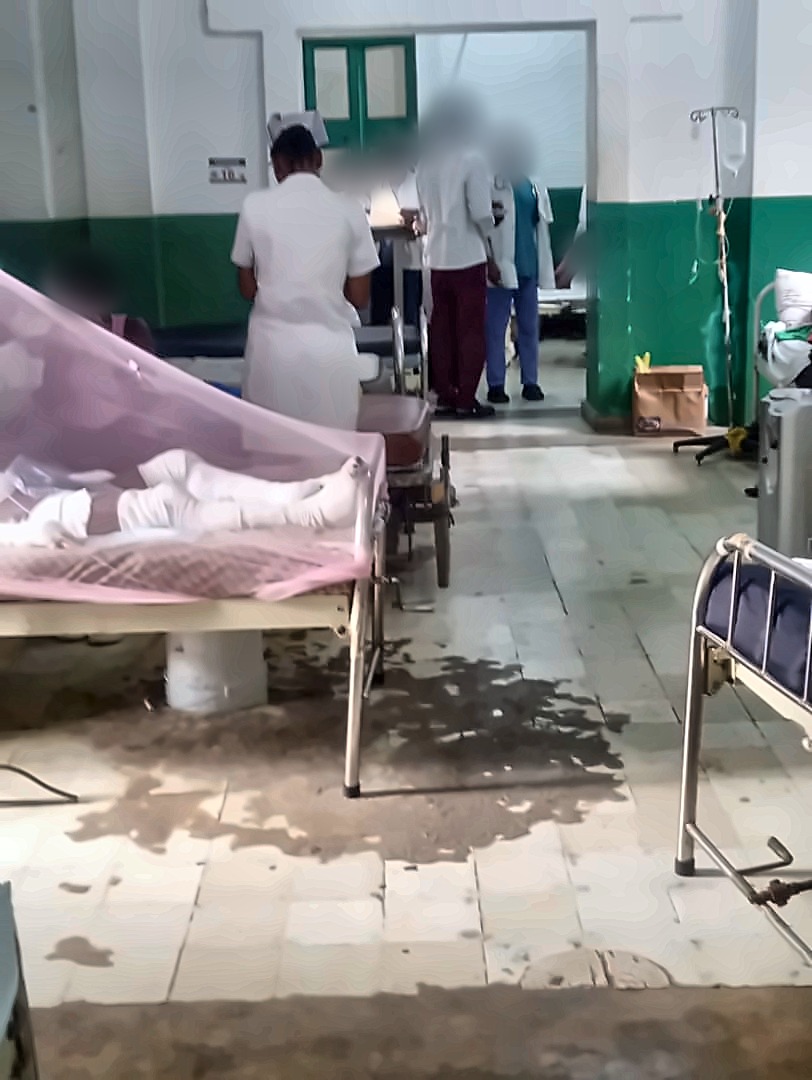
This endless flow of tragedies weighs on the city’s health facilities. At Justinien University Hospital, the largest health institution in the North, the impact is plain to see. Its wards for road-accident victims receive their share of motorcycle casualties every day. There, the trauma beds are never empty. You meet teenagers with broken limbs, fathers who have lost a limb, and survivors living with irreversible head injuries.

For the farming family, the toll is utterly cruel. The son for whom the family land was sold, in the hope of lifting the household out of poverty, comes back to the village either in a coffin or severely disabled. The initial loss of land is then compounded by an unbearable financial burden: medical care and lifelong dependency. The engine that was supposed to carry the family toward independence has become the instrument of its mourning and its final ruin.
Farm produce stuck on the road
For farmers who refuse to sacrifice their land and keep on farming, urban motor traffic remains an executioner. Cap-Haïtien is the natural outlet, the economic lung where the harvests of the hinterland must be sold. Bananas, francisque mangoes, avocados and fresh vegetables travel in precarious conditions.
The first obstacle is time. When a collection truck or the truck of a Madan Sara, those indispensable women traders who buy from farmers and sell in the markets, is stuck for hours at the entrances to the city, the verdict comes quickly under the blazing northern sun. Perishable goods rot on the spot, piled up in the truck beds before they even reach the market stalls. It is a dead loss for the producer, who watches months of work turn into compost on the pavement.
The second obstacle is cost. To make up for lost hours, premature wear from potholes and wildly swinging fuel prices, transporters and middlemen protect their margins at the expense of the weakest. The price offered to the farmer at the edge of the field is cut to the last cent. Sometimes, when the main roads are blocked, the producer tries to carry his few bunches of bananas himself on a moto-taxi. An economic absurdity: the ride can cost more than the market value of the load. The producer works at a loss, strangled by logistics gone mad.
The public response: from asphalt to bus stations
Faced with this socio-economic drama, police crackdowns on moto-taxis are not enough. In July 2026, the city hall and the Haitian National Police (PNH) tightened controls in Cap-Haïtien; since then, drivers have been denouncing the 20,000 gourdes demanded to recover a seized motorcycle, which they call a « double punishment. » Saving the countryside and keeping the city moving depend on structural public policies for collective transport. This transformation is being played out on the edges of the historic center, where the main bottlenecks form.
Much of the hope rests on the Resilient Urban Connectivity and Accessibility Transport Project (RUTAP), financed by a World Bank grant estimated at 120 million U.S. dollars and managed by the Ministry of Public Works, Transport and Communications (MTPTC). The program targets strategic routes: paving the stretch from the International Airport intersection to Boulevard Rue 5, on Cap-Haïtien’s waterfront, and the rehabilitation and widening to four lanes of the section of National Road 3 (RN3) between the SOS intersection, at Madeline, and the Airport intersection, launched in May 2026.
What is at stake in these works goes beyond laying asphalt. The goal is to lay the foundations of a multimodal network. The studies carried out for RUTAP already point the way: relocate the bus station or manage the existing site better, build a turnaround point for tap-taps at Madeline, and ban heavy trucks from the city center. We must go further and build real, modern bus stations at the major intersections on the outskirts, at Madeline and Vaudreuil. The State and the Municipal Commission of Cap-Haïtien could thus break with the model of individual transport:
- ban large cargo trucks and swarms of moto-taxis from the city center;
- organize the transfer of passengers and goods to regulated municipal bus fleets, or encourage agricultural transport cooperatives.
By financing large collective vehicles or community trucks for producers’ associations in Plaine-du-Nord or Limonade, the authorities would offer a workable alternative. The farmer would no longer have to sacrifice his land for a motorcycle, because the collection of his produce would at last be handled collectively, safely and affordably.
Organizing driving schools and driver’s licenses
New roads will not be enough without a deep overhaul of the human factor. Today, most young people who take the handlebars of a motorcycle in Cap-Haïtien learn « on the job, » in the chaos of the alleys, without the slightest notion of the highway code. To stem the flow of injured people to Justinien University Hospital, the State must regulate and organize access to the driver’s license.
The city has a few technical training institutions, such as DHCT (Dominicano Haitiano Centro Tecnológico), which has a driving-school department, but training is far from uniform. The State, through the Directorate of Traffic and Road Police (DCPR) and the Directorate General of Taxes (DGI), must impose a strict framework:
- Enforce the driving-school certificate requirement. The law already demands it: the decree of May 26, 2006 on vehicle registration and traffic provides that student drivers be trained in a driving school before taking the theory and practical test of the traffic service. This certificate, issued by an accredited driving school, must become indispensable for obtaining a license. The measure would standardize theoretical and practical skills.
- Specific modules for two- and three-wheelers. Training centers must include mandatory programs on riding motorcycles. These courses must emphasize braking, blind spots and the vital importance of wearing a helmet.
- Constant checks and penalties. In July 2026, the city hall and the PNH announced that any driver without a valid permanent or provisional license would have their vehicle confiscated (Haïti24, July 11, 2026). The rule now has to be applied everywhere, without arbitrariness, while opening a real path to the license at the same time.
Training drivers from their very first steps on the road is the only way to turn the motorcycle from a deadly danger into a dignified and safe means of transport.
Save the road to save the land
Motor traffic in Cap-Haïtien can no longer be treated as a simple urban-planning problem or a matter of city traffic jams. It is a driver of impoverishment that drains wealth from the countryside, pushes families to sell farmland and decimates the region’s lifeblood. Every plot sacrificed for a two-wheeler is one more step toward food insecurity and the collapse of rural life.
Fixing the entrances to the city, professionalizing public transport and spreading economic activity to logistics hubs are no longer options: they are vital emergencies. « Se lè chwal fin pase, w ap rele fèmen baryè, » says the Haitian proverb: don’t wait until the horse has gone by to shout that the gate must be closed. For the central government as for local authorities, investing heavily in regulated public transport is the only way to lift the sword of Damocles hanging over the Grand Nord. At that price, and at that price only, will we stem the flow of injured people filling the emergency room of Justinien University Hospital and give farmers back the dignity of their labor.
Tabou Network — Madan Sara | Economy
Dieula St Julien
« Nou pa sèlman eritye Ayiti nan men zansèt nou; nou prete l nan men jenerasyon k ap vini yo. Ann remèt yo li nan yon pi bon eta pase jan nou te jwenn li. »
English translation: Tabou Network
Sources and references
- MTPTC, RUTAP, Plan de gestion environnementale et sociale — Réhabilitation et élargissement du tronçon de la RN3 du carrefour SOS (Madeline) au carrefour de l’AICH, July 2025.
- MTPTC, RUTAP, Cadre de gestion environnementale et sociale (CGES), September 2022.
- MTPTC, RUTAP, Cadre de politique de réinstallation (CPR), September 2022.
- Government of the Republic of Haiti, « Le gouvernement renforce les infrastructures routières et aéroportuaires dans tout le pays », June 3, 2025.
- iciHaiti, « Cap-Haitien: First technical visit to the construction site of the RN3 section », May 29, 2026.
- Le Nouvelliste, « Les motos-taxis : analyse de leur fonctionnement, de leur mise en service à aujourd’hui, réussite ou échec ? », 2015.
- Le Nouvelliste, « Le transport à moto en Haïti : entre nécessité et vulnérabilité », 2026.
- Le Nouvelliste, « Diffusion des taxis-motos dans l’aire métropolitaine de Port-au-Prince : paradoxe et controverse », May 27, 2022.
- Rezo Nòdwès, « Cap-Haïtien : Le taxi-moto Chawa Pete, un phénomène dangereux », August 7, 2018.
- Rezo Nòdwès, « Cap-Haïtien : la régularisation des véhicules, un véritable défi », July 24, 2026.
- Haïti24, « Cap-Haïtien-Sécurité : la mairie et la PNH renforcent les exigences pour la circulation routière », July 11, 2026.
- Satellite509, « Cap-Haïtien : 20 000 gourdes pour récupérer une moto saisie, la colère gronde contre le maire Michel Saint-Croix », July 22, 2026.
- Le Moniteur, decree of May 26, 2006 on vehicle registration and traffic, articles 46 and 60, as cited by the Immigration and Refugee Board of Canada, response HTI106134.FE.
- DHCT — Dominicano Haitiano Centro Tecnológico, Cap-Haïtien.
Laisser un commentaire